By Emily-Rose Baker
When in 2014 the Islamic State (also known as ISIS, ISIL or Daesh) seized Mosul, Iraq’s second-largest city located 400km northwest of Baghdad, photography was a forbidden activity punishable by execution. Driven to capture the ‘moral truth’ of the destruction of his native city, however, university lecturer and self-taught photographer Ali Yousif al-Baroodi took clandestine photographs of the bombing of Mosul by ISIS from the safety of his home until the city’s liberation in 2017, after which he began documenting the return to the city of life, arts and culture. [i] The result is a diverse archive of images that attest not only to the ruination of Mosul’s architectural and cultural landscape, but which tell a longer and more complex story about the difficult nature of life in a place haunted by its recent (and not so recent) past.
These works pertain to a genre Al-Baroodi calls ‘Mosulography’: photography that bears witness to the terror of the occupation in Mosul as well as the insistence of hope and revival there after the defeat of ISIS. Collectively, the photographs provide a critical artistic commentary on the contemporary state of Mosul that links the city with a broader history of unresolved political tensions in Iraq and the Middle East. The material destruction of the city in Al-Baroodi’s photographs is unavoidably present. Many of his images afford an arrestingly bleak insight into the scale of devastation caused by urban fighting between ISIS militants and Iraqi government forces in Mosul. They are nonetheless beautiful, with surviving traces of cultural landmarks and Islamic architecture intertwining with the remains of religious buildings, educational institutions and even entire neighbourhoods razed to the ground.
In the west, we have have become comfortably familiar with images of ruination, which are regularly encountered in the news. Elsewhere, ruins are sought out as a form of tourism or as sites of urban exploration. In fact, we are often fetishistically drawn to modern sites of ruin and decay – a phenomenon Svetlana Boym calls ‘ruinophilia’, referring to a contemporary fascination with ruins of all kinds, be they archaeological remains, endangered species or decomposing foodstuffs. Indeed, to behold ruins is to directly encounter or confront the past, and yet the immediacy of such a confrontation can paradoxically serve to screen that which lies beneath – namely, additional layers of trauma. [ii] While Al-Baroodi’s photographs draw global attention to the ravaged topographies of Mosul in the post-ISIS era, equally preserved in these images is the invisible psychological toll of the caliphate on a traumatised and displaced community still coming to terms with its aftermath. Al-Baroodi thus challenges his spectator to apprehend the immaterial ruins obfuscated by their material counterparts.
Walter Benjamin, who witnessed first-hand the architectural decay of post-industrial Paris in the 1930s, likens this probative mode of seeing to the characteristically deconstructive nature of ruination itself. ‘The theory of ruins created by time’, Benjamin argues, ‘should be complemented by the process of deconstruction [Abmontieren], which is the task of the critic’. [iii] By this logic, the cultivation of a gaze with which to detect the hidden details of Al-Baroodi’s work rests on the self-reflexive engagement of the spectator in the historical and cultural delayering of a city in ruins. Only through this critical lens can we observe that Al-Baroodi’s work is characterised by a double register of ruination that manifests in the materiality of the disappearing city itself in the first instance, and in the various allegorical and symbolic ruins to which his images also pertain in the second.

A child stands at the centre of this image, in a demolished playground in the Old City of Mosul, a densely populated area on the west bank of the Tigris River. Surrounded by piled bricks and abandoned vehicles, he becomes part of the post-traumatic landscape as though subsumed by it, with no choice but to play in and amongst the ruins. Exemplified by the swings devoid of their seats and the bare apparatus lit up by sunset, however, lingering in this photograph is a melancholy sense of deprivation and the loss of innocence – reflected in the title ‘Lost Childhood’ – of a child rendered vulnerable by his exposure to the reality of modern warfare.
Formerly a culturally diverse commercial centre marked by religious, ethnic and linguistic heterogeneity, much of the Old City has been reduced to rubble. Efforts to rehabilitate and rebuild Mosul have been marred by economic shortages and political corruption as well as the danger posed by improvised explosive devices (IEDs) that have killed as many as 80 individuals since the city’s liberation.
The following photograph exhibits the charred skeleton of the university library in the Old City which, in addition to the central library and many other libraries in Mosul, was looted and torched by the Islamic State, then hit by 10 lethal missiles during the battle to retake the city from ISIS. Symptomatic of the rootedness of Mosulography in depicting the integration of everyday life within posttraumatic space, our attention is drawn to a woman in the foreground who walks past the library, and whose headscarf matches the red balloons of the 2018 ‘reading festival’, which celebrated the proliferation of previously forbidden cultural activity in the city.

Yet unseen in the photograph is the cultural loss or ‘cultural cleansing’, as UNESCO puts it, that has resulted from the burning of rare books, manuscripts, newspapers, maps and collections dating back as far as the Ottoman era. Not only have these lost resources prohibited the access of Mosul’s inhabitants to knowledge and historical memory, but they also signify the violence inflicted by the regime on cultural diversity in the city from which it has not fully recovered.
The same process of cultural erasure is evidenced in the image below, which invokes the attempt of ISIS to obliterate the religious diversity for which Mosul is known. Bookended by the exposed wires and brick remnants of Mosul’s famous leaning minaret, blown up by the jihadist group in 2017, the jade dome of the Great Mosque of al-Nuri – the only feature to withstand the bombing of the mosque complex – sits on the distant horizon.
While UNESCO received over $50.4m from the United Arab Emirates to restore the ancient heritage site, and while progress has already been made, the harm caused by the loss of such an important and iconic Islamic site has scarred the community – especially given its destruction took place on the Night of Power (Laylat al-Qadr), considered the holiest night in the Islamic calendar. Quoted in The Guardian at the time of the minaret’s bombing, two residents deeply affected by the incident respectively lamented: ‘I felt I had lost a son of mine’ and ‘I felt as though part of me had died’. [iv]
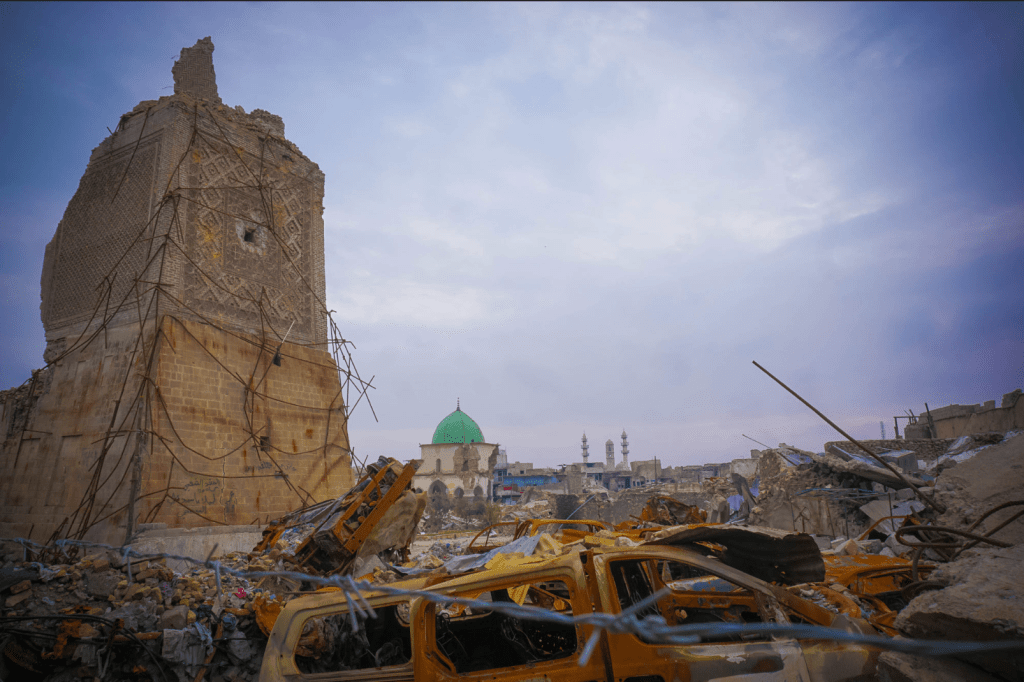
A closer look at these photographs thus reveals the latent trauma lingering beneath the surface of ruins instantly recognisable as such. This in turn brings the painful processes of healing with which Mosul continues to grapple to the fore, including the repatriation of displaced people; the mourning of those killed or taken by ISIS or who ‘disappeared’ during the regime; the revival of arts and culture and the reconstruction of the city’s buildings. The very existence of ‘Mosulography’, however, signifies the prevalence of acts of resistance to cultural and religious cleansing in the city, and the role of art and culture in closing the invisible wounds inflicted by the Islamic State.
In addition to teaching, Ali al-Baroodi has been involved in several projects devoted to reclaiming the city and reviving its heritage. You can view his works on his UNESCO profile here.
Emily-Rose Baker is a final-year PhD student in the School of English at the University of Sheffield. Her research, which examines post-communist Holocaust memory and dreams in central-eastern Europe, is supervised by Professor Sue Vice and funded by the White Rose College of the Arts and Humanities (WRoCAH)
[i] Walter Benjamin, ‘Selected Writings Volume 2, Part 2, 1931-1934’, eds. Michael William Jennings, Howard Eiland and Gary Smith, trans. Rodney Livingstone (Cambridge: Harvard University Press, 1999) p.415.
[ii] Svetlana Boym, ‘Ruinophilia’, The Off-Modern (London: Bloomsbury, 2017) pp.43-48 (p.43)
[iii] Ali Yousif al-Baroodi, ‘Mosulography’, TEDxAUIS, online video recording, YouTube, 1 July 2019 <https://www.youtube.com/watch?v=IjDW_W4uUIw> [accessed 7th April 2020]
[iv] Martin Chulov and Kareem Shaheen, ‘Destroying Great Mosque of al-Nuri is ‘Isis declaring defeat’’, The Guardian online, 22 June 2017 <https://www.theguardian.com/world/2017/jun/21/mosuls-grand-al-nouri-mosque-blown-up-by-isis-fighters> [accessed 6th April 2020]
 Invisible Wounds